

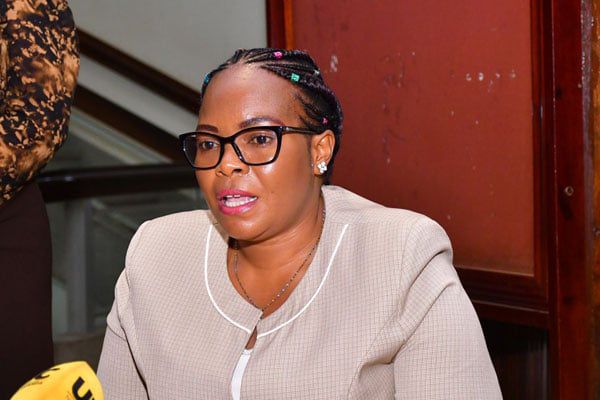
The State minister for Lands, Housing and Urban Development, Persis Namuganza, has accused senior figures within the ruling National Resistance Movement (NRM) of manipulating internal procedures in the selection of parliamentary leadership, warning that the party risks undermining its own democratic processes.
Namuganza said the NRM has well-established procedures for members interested in contesting for positions such as Speaker and Deputy Speaker of Parliament, but alleged that those procedures were interfered with through irregular actions and questionable communications attributed to Yoweri Museveni.
According to the minister, the party traditionally begins the process by calling for expressions of interest from Members of Parliament who wish to contest for top leadership roles in the legislature. Those interested are then required to present their credentials and outline their vision before the NRM Parliamentary Caucus.
“We come to the party as elected Members of Parliament and there is a procedure that is followed,” Namuganza said. “The NRM has always emphasised democracy, and part of that process is allowing members who are interested in positions such as Speaker or Deputy Speaker to express interest and present themselves before the caucus.”
She explained that the procedure allows aspirants to present their credentials, defend their suitability for the position, and answer questions from fellow MPs before a decision is made on who should carry the party’s backing.
Namuganza said the process is designed to ensure transparency and give all interested candidates a fair opportunity to compete.
However, the minister alleged that the procedure was disrupted after members of the NRM Parliamentary Caucus sought a meeting with President Museveni to discuss a range of issues, including matters arising from earlier internal elections.
According to her account, the meeting had been requested so that MPs could raise concerns directly with the president. Museveni, she said, agreed to meet them to listen to the issues they wished to present.
But Namuganza claimed that during the meeting, some officials introduced the issue of the speakership despite it not being part of the original agenda.
“Members of the caucus had gone there with their own issues to discuss with the president,” she said while appearing on a local radio station. “But somewhere along the way the issue of the speakership was introduced, and some people started suggesting that the current leadership should remain.”
Uganda’s Parliament is currently led by Anita Annet Among as Speaker, with Thomas Tayebwa serving as Deputy Speaker.
Namuganza argued that raising the issue in that manner created the impression that a final position had already been reached, even though the party’s internal selection process had not been concluded.
“They think when they discuss it there that the debate is finished,” she said. “Then they come out and tell the public that the matter has already been decided.”
She said such actions risk sidelining other potential candidates who may wish to contest for the positions through the formal party structures.
The minister also questioned a letter reportedly issued after the meeting conveying the president’s guidance on the matter.
Namuganza suggested that the communication appeared irregular and may not have followed the established procedures through which directives from the party chairman are normally transmitted.
According to her, letters conveying the president’s position on internal party matters are typically channelled through the office of the NRM Secretary General before being presented to the parliamentary caucus.
She said the letter circulating in connection with the speakership debate appeared to contain an electronic signature and may have bypassed the normal communication channels within the party.
“Normally when the president writes to the caucus, the communication goes through the Secretary General who then informs the members,” Namuganza said. “But in this case the procedure seems to have been different, which raises questions.”
She added that she had been part of the NRM for many years and was familiar with its internal procedures.
“I have been in this system for a long time and I know how these processes work,” she said. “It is disturbing when people ignore procedures and try to manipulate processes that should be transparent.”
Namuganza also criticised some government officials and party members who have publicly commented on the speakership issue, arguing that such remarks could further complicate an already sensitive process.
Without naming individuals directly, she said officials whose role is to communicate government policy should avoid engaging in internal political debates that are still being handled within party structures.
“When people who are supposed to speak for government start commenting on internal matters of the party, it creates confusion,” she said. “They should allow the proper processes to take place.”
The minister said the NRM prides itself on being a democratic organisation and should therefore ensure that all internal elections are conducted according to the party constitution and established procedures.
She stressed that any attempt to impose decisions outside the agreed structures could create divisions within the party and erode confidence among members.
“The party has a constitution and systems that guide how decisions are made,” Namuganza said. “If those systems are ignored or manipulated, it becomes difficult for members to trust the process.”
Her remarks come amid ongoing debate within the ruling party over how candidates for key parliamentary positions should be selected, particularly in situations where multiple members express interest.
In previous contests, the NRM Parliamentary Caucus has sometimes persuaded some candidates to step down in favour of a single consensus candidate to avoid internal divisions.
Namuganza said such consensus arrangements are acceptable as long as they are reached through dialogue and agreement among members rather than through external pressure.
“If members sit together and agree on one candidate after discussions, that is acceptable,” she said. “But the process must be open and fair to everyone involved.”
She expressed confidence that Members of Parliament would ultimately ensure that the party’s internal processes are respected.
“I believe MPs understand the procedures and will insist that they are followed,” Namuganza said.
